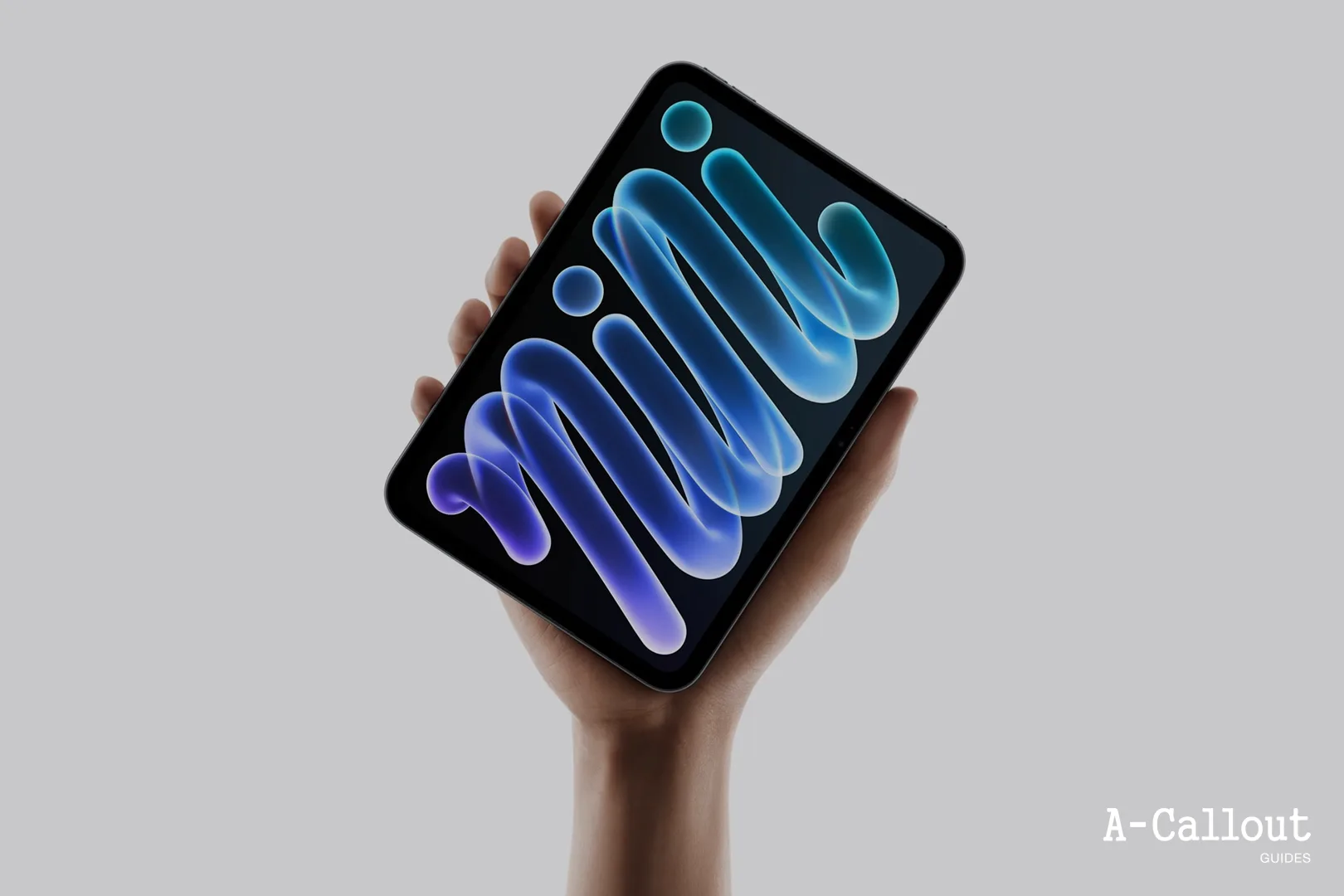
If you want to understand what changed with the latest iPad mini, the answer is not simply that it is faster. The more meaningful shift is physical and experiential: Apple's smallest tablet now feels less like a compact iPad and more like an everyday object designed to be carried, handled, and trusted in more places.
That matters because the iPad mini has always occupied an unusual category. Larger than a phone, smaller than a standard tablet, it is typically chosen for reading, travel, note-taking, field work, and casual browsing. Its value depends less on replacing a laptop and more on whether it feels worth keeping close. With an OLED display, a thinner 5.4mm body, lighter construction, and IP67 water and dust resistance, the new iPad mini makes that argument more clearly than any previous version.
The OLED screen is the most visible change.
Moving from LCD to an 8.5-inch OLED panel brings deeper blacks, richer contrast, and stronger HDR brightness. For a device used in bed, on planes, in waiting rooms, or outdoors between tasks, display quality is not just a specification. It shapes whether the tablet feels comfortable to read, watch, or scroll through for long stretches. The new screen makes the mini feel more complete, especially in the low-light and high-contrast situations where small tablets are most often used.
The thinner profile changes the character of the object just as much.
At 5.4mm thick and 255g for the Wi-Fi model, the iPad mini becomes easier to hold, easier to slip into a bag, and less likely to feel like a compromise. Slimmer bezels allow the larger display to fit into a familiar footprint. This is the point of the redesign: not to make the mini into a workstation, but to make its portability feel considered rather than incidental.
IP67 protection is equally important to that shift.
It does not make the iPad mini a rugged device, and liquid damage remains outside Apple's warranty. But rated water and dust resistance changes how a small tablet can be used day to day. Rain, spills, kitchens, commutes, and outdoor work all become less stressful. The device feels less precious, which is part of what makes it more carryable.
Performance matters, but it is not the defining story.
The A17 Pro chip brings faster CPU, graphics, and on-device AI performance, with higher storage configurations adding more headroom for demanding apps, Apple Intelligence features, gaming, and editing. The larger point is that this performance now sits inside a body better suited to constant movement. The hardware is not merely faster; it is more resolved as a portable object.
Other refinements support the same idea.
The front camera has moved to the landscape edge, better suiting video calls when the tablet is held or propped horizontally. Acoustic Display speakers remove traditional speaker openings while maintaining stereo sound. Wi-Fi 7, Bluetooth 6, Thread, and updated cellular hardware add modern connectivity. None of these details redefine the mini alone, but together they make it feel like a carefully finished device rather than a secondary one.
The tradeoff is price.
At $699, the new iPad mini sits close to the 11-inch iPad Air, which offers a larger screen and a stronger case for document-heavy work. That comparison clarifies each device's purpose. The iPad Air makes sense when screen space and desk-based productivity are the priority. The iPad mini makes sense when the priority is a compact OLED tablet that is easy to carry, comfortable to hold, and more resistant to everyday exposure.
For existing iPad mini owners, the upgrade question depends less on raw speed than on how the current device feels in use.
If an older mini already handles reading, notes, and casual apps well enough, the new model may not be essential. But if screen quality, durability, weight, or confidence outside the home are recurring limitations, this generation addresses those issues directly.
The latest iPad mini is best understood as a design correction.
Apple has not simply made its smallest tablet more powerful; it has made it feel more intentional. The OLED display improves the moments when the mini is most often used. The thin body makes it easier to live with. The IP67 rating makes it less fragile in daily life. Together, those changes reposition the iPad mini as a small tablet worth carrying everywhere, not because it can do everything, but because it finally feels built for the places people actually take it.
November 12, 2026
Related Article