The question around the Bang & Olufsen Powerbank is not simply whether a 5,000mAh battery is worth 145 euros.
Most people searching for it want to understand why an audio company would enter the portable power category at all, and what separates it from the many less expensive magnetic chargers already available. The answer is design intent. This is less about outperforming the category on capacity or wattage and more about rethinking how a power bank should exist among the objects people carry every day.
Most power banks are treated as emergency utilities: useful, anonymous, and visually disposable.
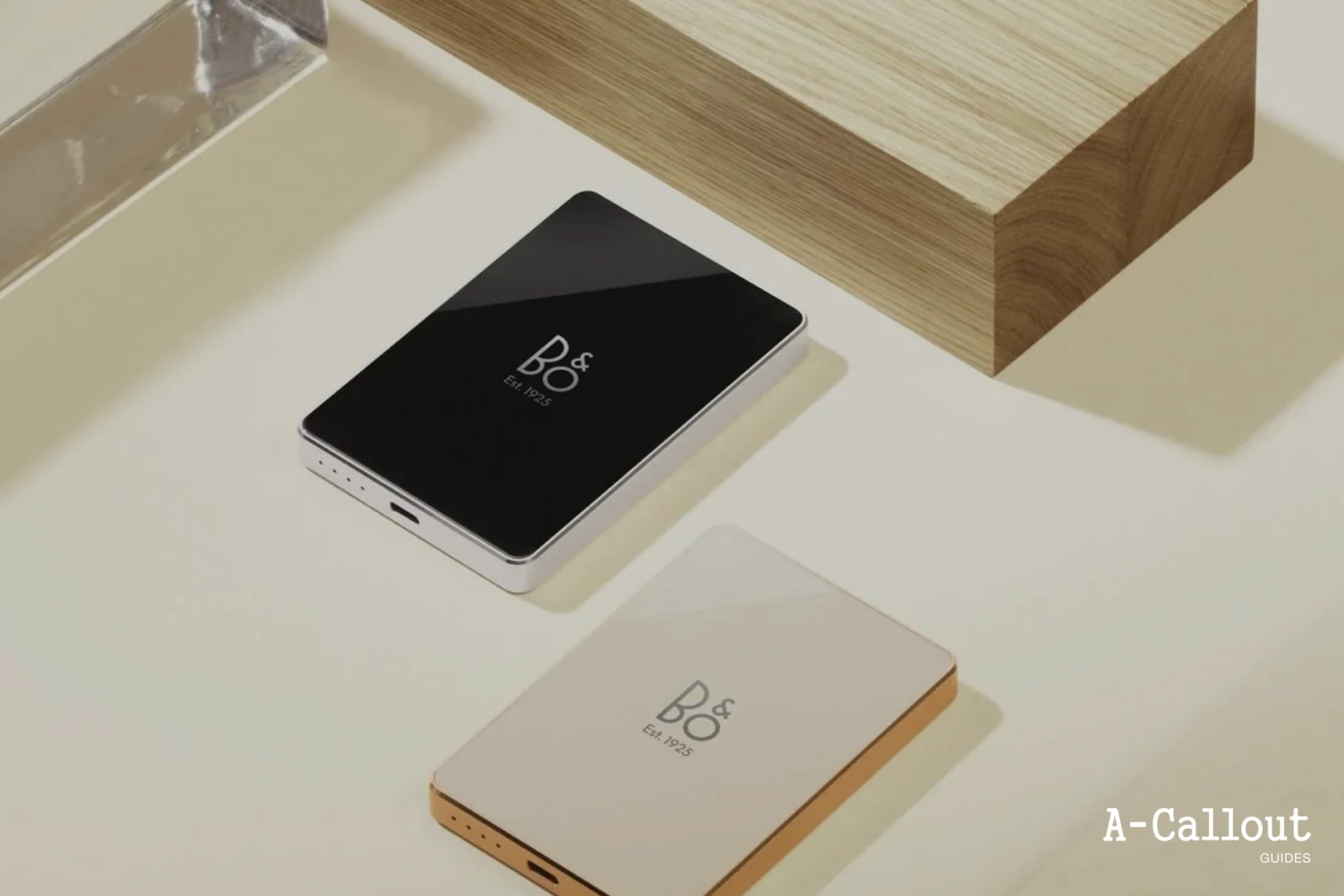
B&O approaches the category as it would a pair of headphones or a speaker, as an object expected to be seen, touched, and kept close. The Powerbank is built from glass and aluminum, with diamond-cut detailing and pearl-blasted textures. It comes in Infinite Black and Hourglass Sand, colorways chosen to complement the Beoplay H100 headphones. That relationship matters because the product is not positioned as a generic accessory with a logo attached. It is designed as part of a coherent material and visual language, sharing the same sense of finish as the brand's audio lineup.
The specifications are straightforward: 5,000mAh capacity, Qi2 magnetic wireless charging at up to 15W, 20W wired USB-C output, and USB-C recharging at up to 18W.
For Beoplay H100 owners, five minutes of charging can provide up to 3.5 hours of additional playback. These are useful qualities for travel and daily carry, but they are not the reason the product exists. That distinction is central to understanding the price.
Other Qi2 power banks with similar performance cost less.
Bang & Olufsen is not competing on raw output or value-per-watt. It is asking whether a category dominated by plastic rectangles can support a more deliberate kind of object, one whose material presence matters as much as its function.
This makes the Powerbank a revealing product even for people who may never buy it.
Phones, headphones, watches, wallets, and chargers all occupy the same personal space. They sit on desks, pass through airport lounges, and live in hands and pockets. When an object is used that often, its texture, proportion, and finish become part of the experience. B&O's argument is that a power bank does not have to be hidden at the bottom of a bag.
The glass surface, aluminum frame, coordinated colors, and precise edges are not incidental decoration; they are the point.
They turn a backup battery into a considered carry object, in the same conversation as a watch or wallet. That does not make it the right choice for everyone.
Anyone prioritizing maximum capacity, fastest charging, or lowest price will find little reason to choose it.
But the Powerbank is not built around that kind of calculation. It is a design-led product in a utility category, and its significance lies in that tension. As more technology becomes portable, the objects that support it become part of personal style and daily ritual. Bang & Olufsen's Powerbank is a reminder that even the most ordinary device deserves aesthetic scrutiny when it lives close to the body.
July 23, 2026