What should an electric Ferrari feel like inside? At a moment when luxury EVs compete through ever-larger touchscreens and software updates, Ferrari's first electric model proposes a different answer. Rather than amplifying the digital spectacle, the Luce reduces it. Shaped in collaboration with Jony Ive and LoveFrom, its cabin asks whether an electric future can be defined not by screens, but by physical clarity.
This is the core shift the Luce represents. As battery statistics dominate headlines, Ferrari has framed its inaugural EV around sensory experience. The interior functions less as a rolling device and more as a calibrated instrument, where material, resistance, and motion carry as much meaning as pixels.
A Mechanical Interface, Not a Digital Overlay
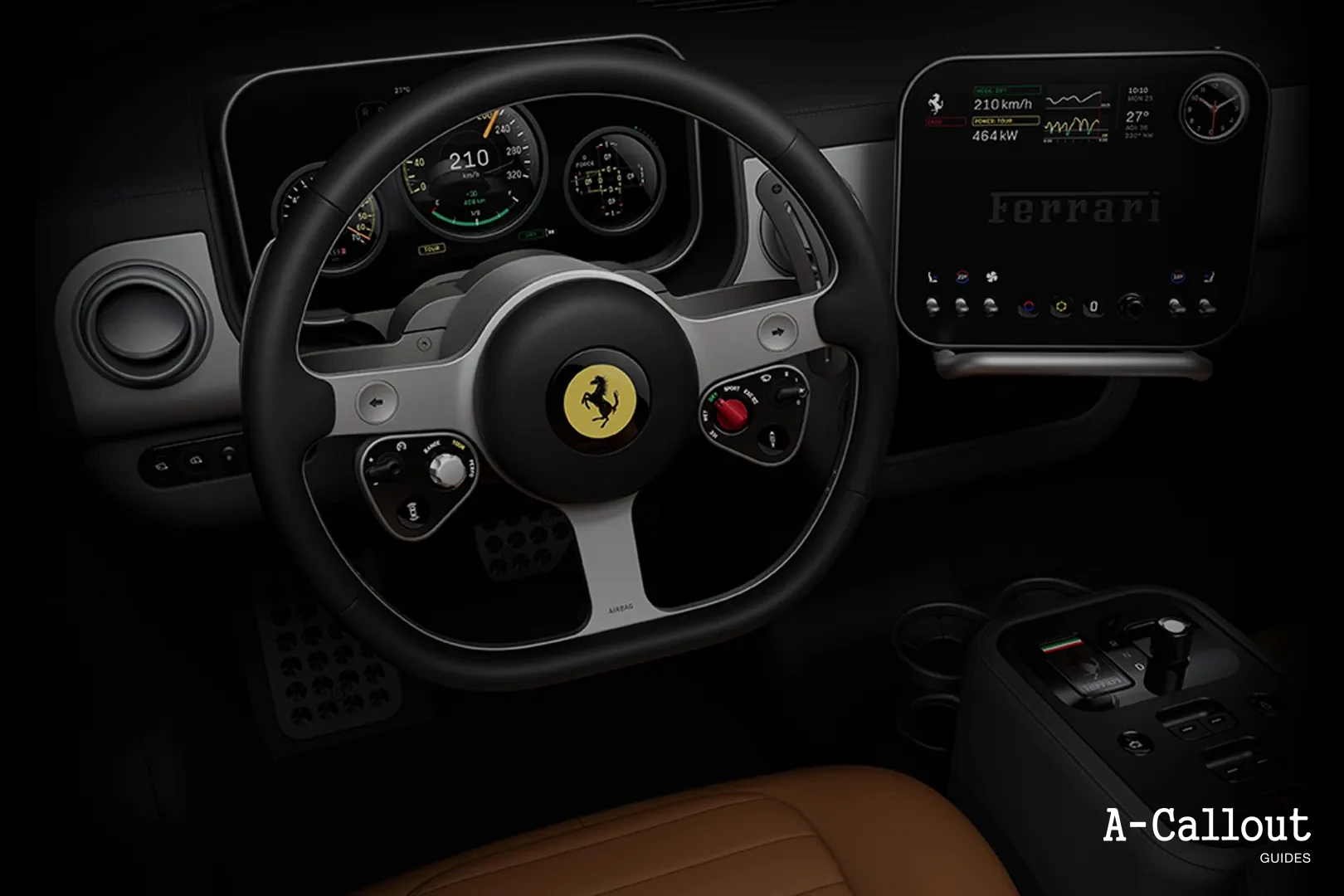
The steering wheel makes this immediately clear. Machined from recycled aluminum and assembled from precisely CNC-milled components, it serves as a mechanical interface rather than a nostalgic gesture. Inputs are handled through tangible controls: metal switches, sculpted manettini, and paddles managing torque and regenerative braking. The wheel controls input; the binnacle delivers output. Each function has a defined physical place.
In an era when haptic feedback substitutes for real tactility, the Luce insists on actual mechanical action. Toggle switches were selected for functional clarity, not retro appeal. Physical climate controls return. Even the pivoting central display mounts on a ball-and-socket joint with a palm rest to avoid imprecise jabbing. As Ive articulated, touch alone does not belong at the center of the driving experience.
Embedded Technology, Invisible Spectacle
This does not mean the Luce rejects digital technology. Its displays use advanced OLED panels for deep contrast. A proprietary multigraph combines clock, chronograph, and performance data through coordinated mechanical movement. Corning-engineered Fusion5 glass, laser-perforated and semi-matte, resists fingerprints while maintaining optical clarity. Technology is present everywhere, just rarely as spectacle. It is embedded and often invisible.
Material discipline anchors the cabin. Anodized aluminum with micro-machined structure, lens-like instrument glass, articulated air vents, and a key with e-ink transformation when docked all contribute to a coherent language of precision. Fasteners and tolerances become visible expressions of care. The absence of exposed plastic is not a boast but an ethos.
Differentiation Through Reduction
This approach positions the Luce against a prevailing trend: the conflation of innovation with interface density. Many EVs seek legitimacy through digital abundance. Ferrari differentiates its electric identity through reduction. The interior avoids the aesthetic of a tablet mounted to a dashboard, replacing it with layered components reminiscent of watches and cockpit instruments.
For Ferrari, this is more than aesthetic. Moving to a fully electric platform risks severing sensory cues that historically defined the brand. By intensifying tactile feedback and material richness, the Luce compensates for what electric drivetrains naturally remove. Mechanical switches, sculptural dials, and amplified authentic sounds work to restore emotional texture.
Post Spectacle Luxury
The result is not anti-technology but post-spectacle. The Luce suggests that electric luxury may depend less on information displayed than on how clearly it is framed and meaningfully touched. The cabin becomes the car's primary statement of intent.
As EVs mature, differentiation will depend less on range and more on character. Ferrari proposes that character can still be machined, weighted, and felt. The Luce interior reframes the electric transition not as digital inevitability, but as an opportunity to bring craft back into focus.
March 5, 2026
Related Article