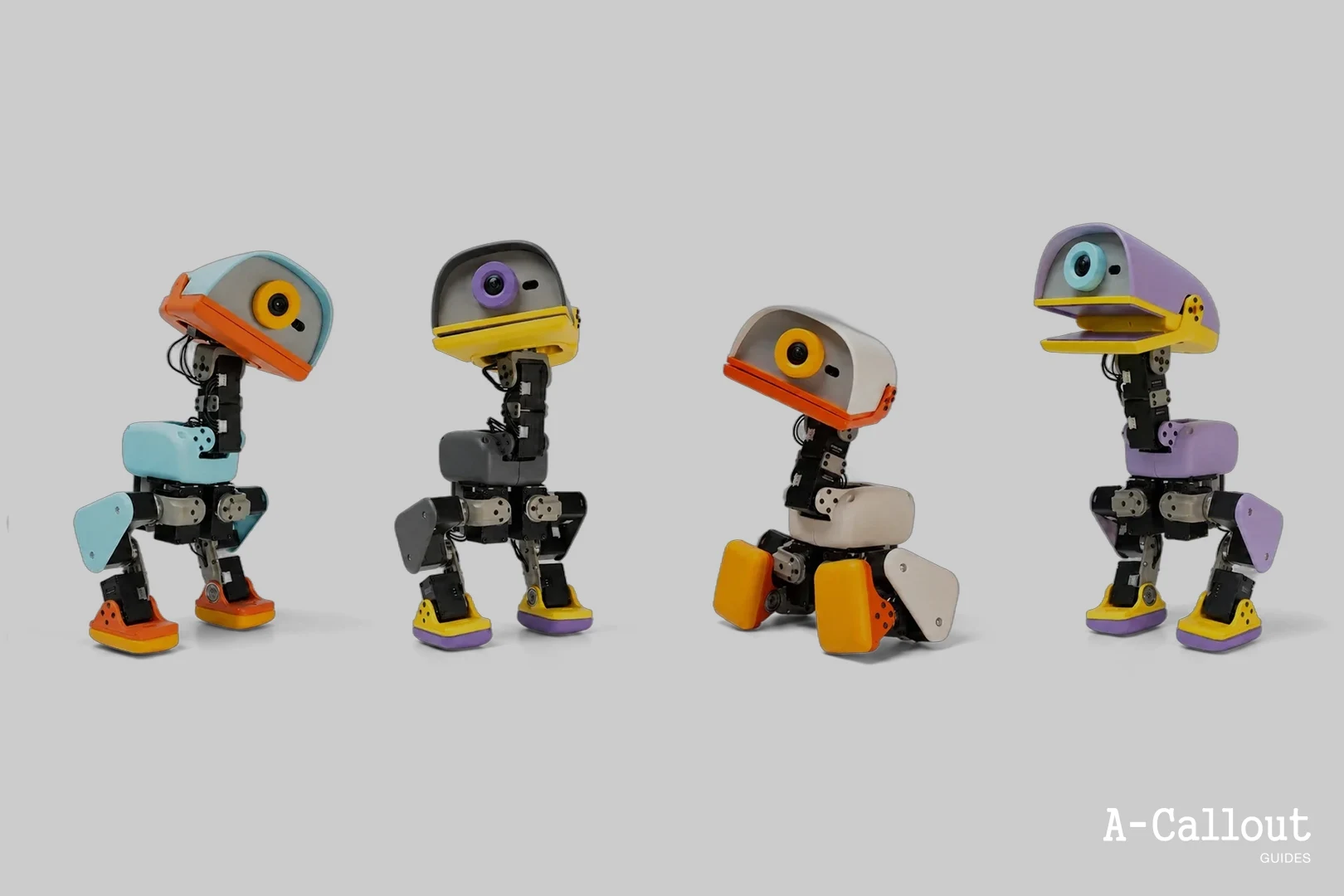
For anyone trying to understand the Pollen Robotics Microduck, the central question is simple: is this small duck-shaped machine a toy, a companion robot, or a serious programmable platform? The answer is what makes it interesting. Microduck sits between those categories, using character design, open-source software, and physical interaction to suggest a different future for consumer robotics.
That matters because much of the robotics industry is still framed around capability at human scale: humanoid bodies, household labor, complex mobility, usefulness as the highest measure of progress. Microduck takes another route. At 25cm tall and priced at $399, it does not try to look like a person or promise to reorganize domestic life. It asks whether a home robot can feel approachable, expressive, and personal before it becomes broadly useful.
Its duck form is not a novelty pasted onto a machine.
It is the point of view. The compact body, waddling motion, optional roller-skate-style wheels, and functional gripping beak all turn technical features into gestures with personality. A beak that grasps small objects could have felt like a mechanical claw; here it reads as part of the character. The design makes the robot legible, emotionally immediate, and easy to understand at a glance.
Underneath that softness is a capable programmable robot.
Microduck includes LiDAR, a camera, depth sensing, two IMUs, NFC interaction, 15 motors, a microphone, and a speaker. It can walk, crouch, sit, recover from falls, pick up small objects, and interact with tagged objects or other Microducks. These are not humanoid-scale ambitions, but they are meaningful forms of movement and presence in the physical world.
The open-source framework is central to the concept.
Pollen Robotics, part of Hugging Face, positions Microduck as both an interactive consumer object and a development platform. Its SDK, simulation environment, and reinforcement learning tools allow users and developers to shape robot behavior rather than simply consume prepackaged functions. The relationship feels more creative than transactional.
This is where Microduck differs from most smart home devices.
A speaker, camera, or appliance tends to disappear into service. Microduck is designed to be noticed. Its value lies not only in what it accomplishes but in how it occupies a room, responds to interaction, and invites experimentation. It treats presence as a feature.
It also reframes accessibility in robotics.
Many trainable robots are expensive, large, or aimed at engineering labs. Microduck's scale and price do not make it simple, but they make physical AI more culturally approachable, giving robotics a form that feels less like industrial equipment and more like something a person might develop a fondness for.
The home robot does not have to begin as a perfect assistant.
It may begin as a character: small enough to live with, flexible enough to program, and distinct enough to remember. Microduck's achievement is not that it outperforms humanoid robots. It sidesteps that comparison entirely.
If consumer robotics is going to become part of everyday culture, the winning form may not be the most humanlike machine.
It may be the one that feels most clearly itself. Microduck's promise is that the robot in the home can be intelligent without being cold, capable without being overbearing, and useful without losing its sense of play. The future, in this case, is not marching toward us. It is waddling.
September 17, 2026