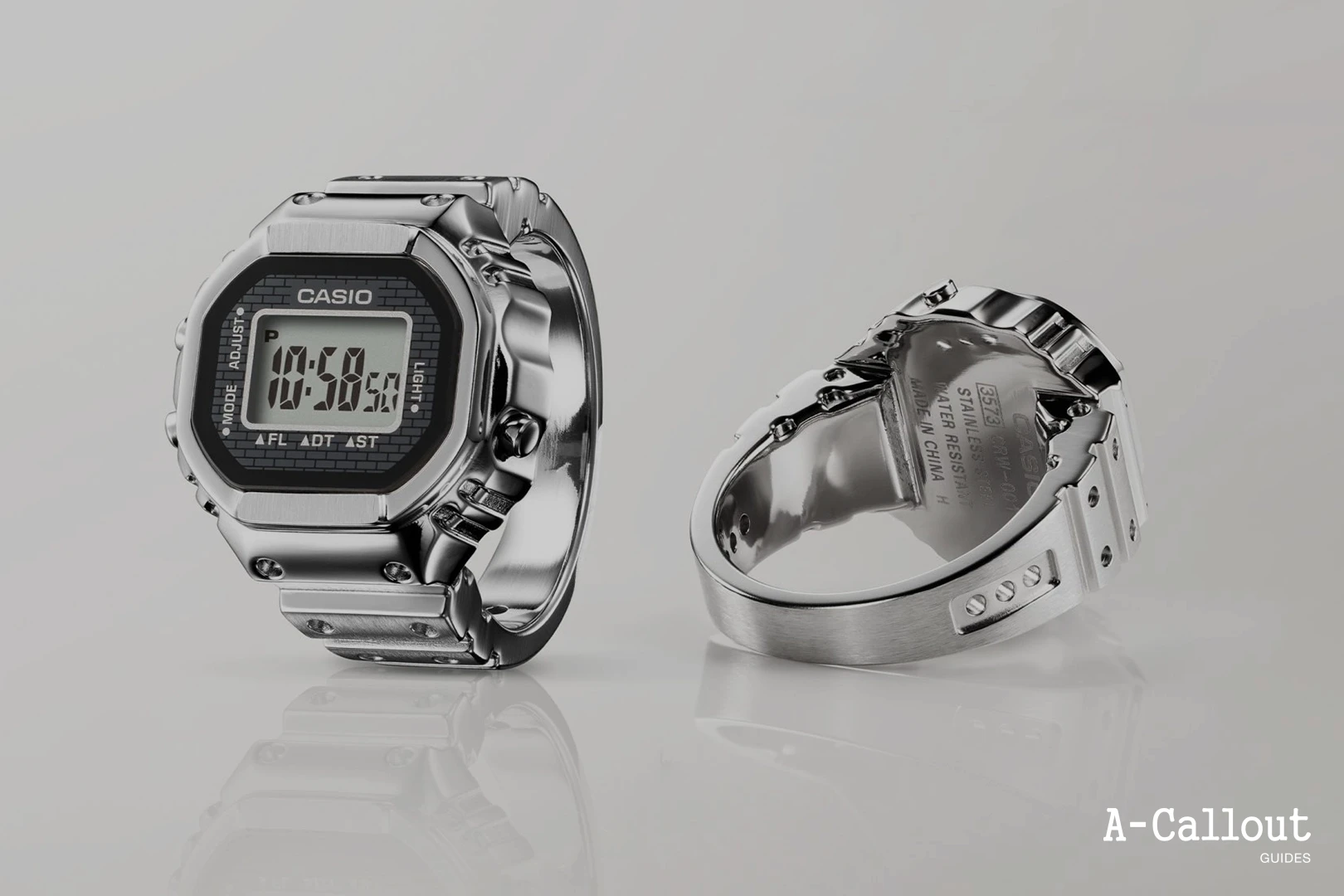
The Casio CRW-H001M-8 answers a question that has quietly shaped the smart ring category: does health tracking have to disappear in order to feel sophisticated? Most smart rings treat invisibility as the ideal. They are smooth metal bands designed to look neutral, gather biometric data, and stay out of the way. Casio takes the opposite position. It puts a tiny LCD face on the finger and makes the wearable recognizable as a Casio.
That matters because the CRW-H001M-8 is not just another health-tracking ring. It includes heart rate monitoring, sleep tracking, SpO2 readings, body temperature sensing, step counting, workout modes, vibration alerts, and app syncing, but its defining feature is visual identity. In a market led by screenless rings from Oura and Samsung, Casio is treating the finger as a place for function, display, and personality.
The appeal starts with the LCD.
Casio's segmented digital display carries decades of cultural memory, from calculator watches to G-SHOCKs to affordable everyday timepieces. On the CRW-H001M-8, that language is compressed into a micro watch face. The result is less discreet than a conventional smart ring, but more legible as an object. It tells the time directly and includes classic Casio functions: world time, a second time zone, stopwatch, auto calendar, 12/24-hour formats, hourly time flash, and LED backlight. This is not a band pretending not to be technology. It is technology with a face.
The tradeoff is physical.
At 19 grams, the CRW-H001M-8 is significantly heavier than typical smart rings, which often weigh only a few grams. That difference is not cosmetic. Sleep tracking, one of the main reasons to wear a smart ring, only works if the ring is comfortable enough to keep on overnight. Casio has added meaningful health sensors, but inside a form that remains closer to a miniature watch than a nearly invisible tracker.
Casio has made the format more credible than its earlier ring watch.
The CRW-H001M-8 comes in small, medium, and large sizes rather than relying on one size with plastic spacers, which matters because optical sensors need direct skin contact. The health module reads from the inner surface, monitoring heart rate, blood oxygen, body temperature, sleep, steps, calorie estimates, and activity modes including walking, running, cycling, and menstrual cycle tracking. Bluetooth connects the ring to the AIZO Ring app on Android, iOS, and HarmonyOS, while a vibration motor handles calls, messages, alarms, and health alerts.
The battery structure reflects Casio's hybrid thinking.
The smart module lasts four to six days per charge and uses a magnetic pogo-pin USB connector. The LCD watch function runs on a separate battery rated for around two years. That separation lets Casio maintain an always-readable watch identity without forcing the display to compete with the health sensors.
The CRW-H001M-8 is not a simple Oura alternative.
Priced at roughly $294 in China, it undercuts some premium smart rings on hardware, but the comparison depends on more than sensors. Health wearables are judged by interpretation as much as measurement. A ring can collect heart rate, sleep, SpO2, and temperature data, but the value comes from how clearly the software turns those readings into useful context. Casio's reliance on the AIZO Ring app makes the software experience a central question, not a footnote.
Availability is another constraint.
The CRW-H001M-8 is launching in mainland China in silver, with sales and support tied to that market. Casio has expanded earlier ring watch models internationally over time, but a wider rollout is not confirmed. For now, its significance is as much conceptual as commercial: it demonstrates how smart rings might evolve if they stop treating anonymity as the only valid design goal.
The CRW-H001M-8 is compelling because it reframes the smart ring as an expressive everyday object.
It accepts bulk, visibility, and a slightly eccentric presence in exchange for direct timekeeping, alerts, and a familiar Casio interface. For some users, that will be too much ring. For others, it may be the first smart ring that feels chosen rather than merely tolerated.
Casio's bet is that wearable health technology does not have to look clinical to be taken seriously.
The CRW-H001M-8 brings biometric tracking into a design language built on charm, utility, and nostalgia. In doing so, it reminds the wearable industry that character is not the opposite of function. Sometimes it is the reason an object earns a place on the body.
August 20, 2026
Related Article