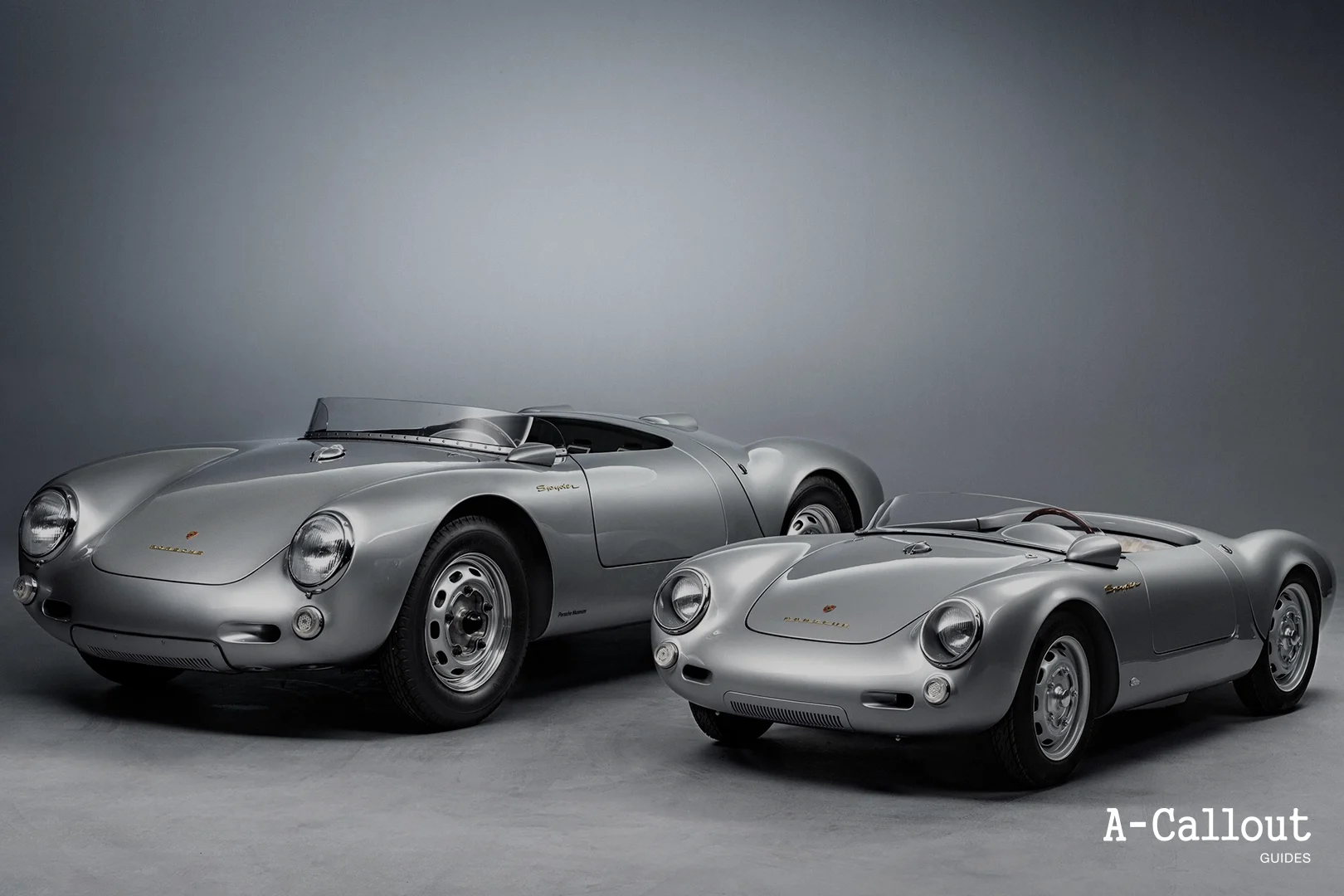
Readers searching for the Porsche 550 Spyder J are usually trying to understand what it actually is: a miniature Porsche, an electric replica, a luxury toy, or a serious collector's object. The answer is more interesting than any of those. Hedley Studios' 550 J is an officially licensed, 80-percent-scale reimagining of the Porsche 550 Spyder, hand-built in the UK, fully electric, limited to 250 examples, and not road-legal. That last detail is not incidental. It defines the object.
Because it is not intended for public roads, the 550 Spyder J does not need to behave like a conventional car. It can be smaller, more intimate, more theatrical. Designed for private estates and controlled environments, it has a top speed of around 50 mph, a 48-volt electric powertrain, and a compact two-seat format that place it outside the normal logic of automotive utility.
That is what makes the project culturally revealing.
Hedley Studios has taken one of Porsche's most mythologized forms and rebuilt it not as a continuation model but as a collectible design artifact. The original 550 Spyder was a lightweight, mid-engined racing car developed specifically for motorsport, remembered for its Carrera Panamericana success and for helping establish the Carrera name within Porsche culture. The 550 J does not attempt to reproduce that machine as a usable historic racer. Instead, it translates its silhouette, proportions, and symbolism into a contemporary luxury object.
The construction reinforces that shift.
The 550 J uses a steel space-frame chassis and carbon-fibre body rather than copying the materials and mechanical formula of the 1950s original. Its electric drivetrain produces around 8 kW in standard form, or up to 16 kW with the RS Package. These numbers matter less as performance statistics than as clues to intent. This is not a car built to compete with modern sports cars. It is a controlled, scaled, highly finished object built around presence, touch, memory, and display.
Calling it a toy is tempting given the scale, but it misses the point.
Toys are defined by play; this object is defined by authorship, licensing, craft, scarcity, and cultural reference. Calling it a replica is also incomplete. A replica aims to stand in for something absent. The 550 Spyder J is more selective than that, borrowing the visual and emotional code of an icon while openly changing the format: smaller, electric, limited, and separated from road use.
Its appeal is closer to collectible design than to traditional car ownership.
The limited run of 250 units, the official Porsche connection, and extensive personalization options position it within the world of luxury objects as much as the world of vehicles. Heritage-inspired colors, motorsport liveries, and bespoke configurations allow each example to act as a private interpretation of Porsche history. The object becomes a way of owning a compressed version of a story: the racing 550, the Carrera mythology, the open cockpit, the idea of speed made intimate.
That intimacy is central.
At roughly 2.9 metres long and 1.2 metres wide, the 550 J is deliberately reduced but not diminished. It still accommodates two people, giving it a social quality absent from static sculpture. Yet its limits keep it from becoming ordinary transportation. It occupies a charged middle ground: drivable but not practical, engineered but not utilitarian, nostalgic but not mechanically old-fashioned.
This is why the 550 Spyder J matters beyond novelty.
It shows how automotive heritage is increasingly being reframed through the language of design collecting. Value is not only in horsepower or road performance. It is in proportion, provenance, material, licensing, scarcity, and the emotional power of a recognizable shape. Hedley Studios has not simply made a small electric Porsche. It has made a private-scale monument to one of the brand's most storied silhouettes.
The 550 Spyder J is best understood as a luxury design artifact with automotive behavior rather than a car reduced for amusement.
It belongs to the same cultural space as limited-edition furniture, collectible watches, and commissioned objects whose function is inseparable from symbolism. Its purpose is not to replace the original 550 Spyder or recreate its competitive edge. It is to make the mythology ownable in a new form: compact, electric, hand-built, and deliberately removed from the everyday road.
October 1, 2026